Routing Integration
Integration
For projects using FlexRay, CAN, and PDU transport, the Integration class provides
a ready-to-go implementation of the instantiation of the routing components.
The Integration class uses the blob module to access configurations, which can be loaded
from memory using the load functions.
Getting started
Generate routing-related blob artifacts with the blob generator tool.
Provide an
::etl::span<uint8_t const>over the generated blob bytes and validate it withblob::load(). Treat an empty returned span as a configuration error and do not continue routing initialization with it.Pass the validated span to
PduTransportIntegration::init()andIntegration::init().Provide bus and socket endpoints (CAN/FlexRay readers and writers, UDP sockets) to these
init()calls.Call
PduTransportIntegration::activate()once the network stack is up. This binds and joins the UDP sockets and enables the RX/TX direction of each PDU transport channel according to its configured mode and VLAN. Untilactivate()has been called, no UDP data is received or transmitted, even thoughinit()has already built all tables and adapters.In the periodic task, call
checkTransmissionTimeouts()andsendUdpFrames()onPduTransportIntegrationandroute()onIntegration(see Lifecycle and workflows).On shutdown, call
PduTransportIntegration::disable()to close the sockets and tear down the receivers/senders.
Note
The socket API is not thread-safe. activate(), disable(), checkTransmissionTimeouts(),
sendUdpFrames() and route() must all be driven from the same task/context that owns the
network stack. See Threading and concurrency for the full concurrency model.
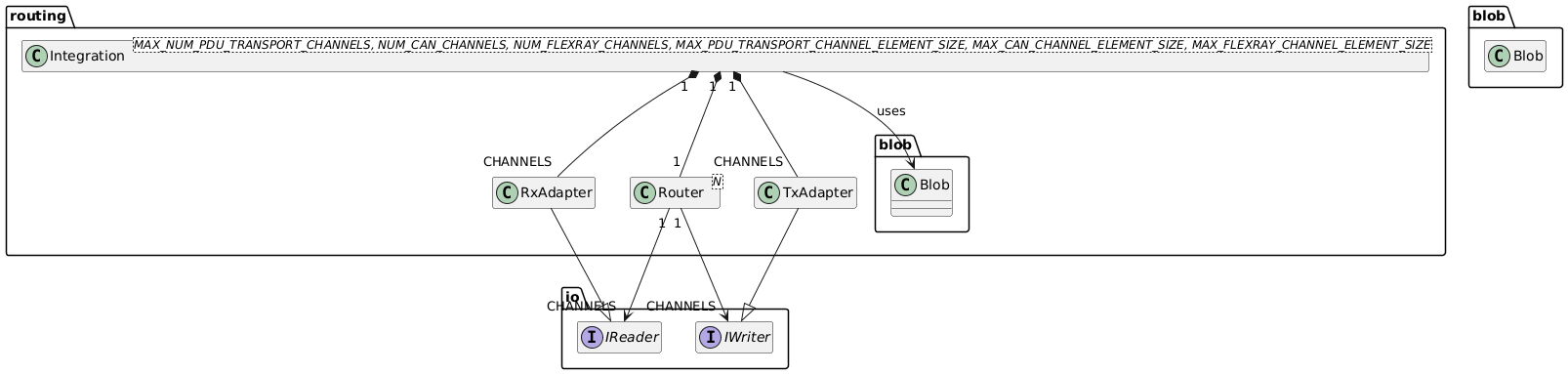
Here is the structure of this class, with regard to the Routing components (note that
CHANNELS = PDU_TRANSPORT_CHANNELS + CAN_CHANNELS + FLEXRAY_CHANNELS):
PDU Transport Integration
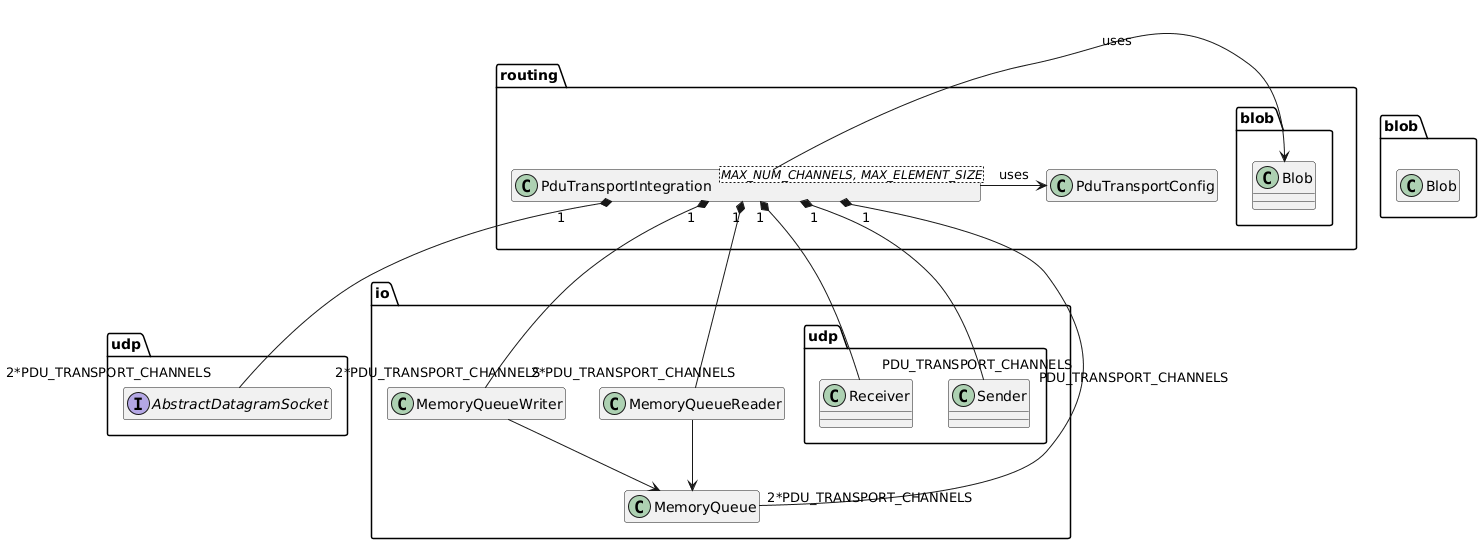
The PduTransportIntegration class takes care of instantiating all the components related to the UDP-based PDU
transport communication, except for the sockets. The sockets are provided at initialization and their type has
to derive from AbstractDatagramSocket. PduTransportIntegration separates frame creation from
socket transmission:
PduTransportBufferedWriterbatches outgoing PDU transport messages into frame-sized queue entriescheckTransmissionTimeouts()evaluates whether buffered frames must be committed to TX queues because of configured timeoutssendUdpFrames()begins the actual UDP transmission by reading frames from the TX queue and sending up to 10 frames per channel per call through sockets
As a result, data already written to TX queues may still not have been sent out. Data is written to the TX queue when the next message would no longer fit into the current frame buffer or the configured transmission timeout expires. The timeout starts with the first committed message in an empty frame buffer, not with allocation.
The structure of this class is the following:
If we look at the way these components are interconnected and connected with the Integration class, we get:
![component Integration {
() IReader as ir1
() IWriter as iw1
[Router]
[RxAdapter]
[TxAdapter]
}
component PduTransportIntegration {
() IReader as ir4
() IWriter as iw4
[Receiver]
[MemoryQueue] as mq1
[MemoryQueue] as mq2
[Sender]
() AbstractDatagramSocket as isock
() AbstractDatagramSocket as osock
}
() IReader as ir3
() IWriter as iw3
[UdpSocket] as iudp
[UdpSocket] as oudp
[Router] -left-( ir1
[Router] -right-( iw1
[RxAdapter] -right- ir1
[TxAdapter] -left- iw1
[RxAdapter] -down-( ir3
[TxAdapter] -down-( iw3
mq1 -up- ir3
mq2 -up- iw3
mq1 -left- iw4
mq2 -right- ir4
[Receiver] -right-( iw4
[Sender] -left-( ir4
[Receiver] -down-( isock
[Sender] -down-( osock
iudp -up- isock
oudp -up- osock](../../../../_images/plantuml-e92be36e3aaa17da2566102a8552f532270f9e83.png)
Lifecycle and workflows
The routing components are plain objects with explicit init/activate/disable phases;
they do not own a task and never allocate. The integrating system owns the lifecycle and schedules
the runtime calls.
- Initialization
Entry points:
PduTransportIntegration::init(),Integration::init().Parse the already validated blob span, discover the configured channels, build the RX/TX adapter tables and the routing table, and connect the readers/writers. No socket or bus I/O happens yet.
init()is idempotent: a second call on an already-initialized instance is ignored.- Startup
Entry points:
PduTransportIntegration::activate(), plus registering the bus listeners and starting the periodic task.Bind and join the UDP sockets, enable the RX and/or TX direction of every PDU transport channel whose configured VLAN matches, and start driving the runtime loop.
activate()clears the RX/TX queues and resets the buffered writers, so it is safe to call again to re-activate after adisable().- Runtime
Entry points:
checkTransmissionTimeouts(),sendUdpFrames(),route().Executed at the cadence chosen by the integrating system. See below.
- Shutdown / de-initialization
Entry points:
PduTransportIntegration::disable(), plus deregistering the bus listeners and cancelling the task.Disconnect and close all sockets and destroy the receivers/senders. The parsed tables remain valid, so the instance can be re-activated with
activate()without re-runninginit().
The runtime step performs three actions, in order:
checkTransmissionTimeouts()flushes any buffered TX frame whose transmission timeout has expired or is within the implementation’s early-flush margin, bounding TX latency.sendUdpFrames()drains the TX queues to the sockets, sending at most a fixed number of frames per channel per call (a compile-time constant, currently 10, inPduTransportIntegration).route()moves PDUs from the RX side to the TX side of the router (see Performance and efficiency).
Threading and concurrency
The routing pipeline is designed around single-threaded execution of the router and the socket I/O, with lock-free hand-off queues bridging any other context that produces or consumes PDUs.
Router / PDU transport context.
route(),checkTransmissionTimeouts(),sendUdpFrames(),activate()anddisable()must run in one and the same context — the one that owns the network (socket) stack. The socket API is not thread-safe, so this constraint is mandatory, not merely advisory.UDP reception happens as a data-listener callback from the network stack (same context) and is written into a per-channel RX
MemoryQueue.Legacy bus reception (CAN/FlexRay) typically happens in a different driver context. The driver’s frame callback writes the PDU into a single-producer/single-consumer (SPSC)
MemoryQueue; the router reads from it in its own context. This queue is the only synchronization primitive needed — it is lock-free and wait-free for one producer and one consumer, so no mutex is taken on the hot path.
Consequently the only cross-context sharing is through MemoryQueue instances, each restricted to
exactly one producer and one consumer. Do not call any router or PDU-transport method concurrently
from two contexts.
Performance and efficiency
The module targets constrained, hard-real-time ECUs. The most important characteristics for an integrator to size and tune the pipeline are:
Static, allocation-free. All buffers are fixed-capacity
etlarrays/vectors sized at compile time from the template parameters; there is no heap use at init or runtime. The memory footprint is deterministic and given by the formulas in Routing Interface.Span-based, bounded copying. Configuration data is read in place from the validated blob span. Routed payload bytes are copied when adapters extract PDUs and when writers emit output PDUs or cross queue, bus, or socket boundaries.
One PDU per
route()call, round-robin.route()inspects the channels in a rotating order and returns after forwarding a single PDU (or after one full sweep finds nothing). This guarantees fairness across channels and a bounded, predictable per-call cost, but it also means the routed throughput equals theroute()call rate. To raise throughput, callroute()in a loop until it returnsfalse(drain), or increase the task frequency — trading CPU headroom for latency.Frame batching on TX.
PduTransportBufferedWriterpacks multiple PDUs into one Ethernet frame up to the configured channel element size. This amortizes the per-frame IP/UDP overhead. A frame is committed when the next PDU no longer fits or the per-channel transmission timeout expires; the timeout therefore bounds the added latency of batching. Set the timeout to0to disable batching latency at the cost of protocol overhead.Bounded socket work.
sendUdpFrames()sends at most a fixed number of frames per channel per call — a compile-time constant (currently 10) inPduTransportIntegration, not a runtime- or blob-configurable value. This keeps the worst-case execution time of a single runtime step bounded even under burst load; backlog is drained over subsequent calls. Changing the cap means editing that constant.Blob read in place. The configuration blob is span-based and allocation-free (see the
blobmodule design), so the routing tables need not be copied into routing-owned RAM before parsing.